
Key Takeaways
Introduction
Traders look for reliable execution, competitive pricing and sufficient market depth when choosing a broker. Contemporary traders also demand rapid order handling and access to diverse financial instruments through a single platform interface. As brokers expand their instrument range and trading volumes grow, choosing the right liquidity provider becomes a critical operational and commercial decision.
When the quality of order fills declines or spreads widen unpredictably, active traders will migrate to your competitors. Maintaining high execution standards protects your brokerage from brand erosion and minimises costly trade disputes. Plus, a stable technical infrastructure helps ensure that backend risk controls function properly during market stress, allowing you to manage client volume without disruption.
Your client retention capacity heavily depends on how smoothly you route trades and fill orders. The bottom line is you should be able to deliver reliable execution experiences during both quiet trading sessions and sudden volatility spikes. But consistently fulfilling trader expectations requires stable underlying market architecture.
A liquidity provider is a market participant or institution that facilitates trading in financial instruments by supplying liquidity and execution access. They bring market depth, bid-ask quotes and order-matching capabilities to electronic trading venues and stand ready to buy or sell specific assets.
Without access to external liquidity, brokers may need to rely more heavily on internal order matching or risk internalisation. This can lead to thinner order books, wider spreads and a higher risk of order rejections, particularly for larger trades.
By connecting to an institutional liquidity provider, brokers gain access to continuous price discovery and available market liquidity. This can support more efficient order execution at market-driven prices.
Financial institutions can source execution capability across several operational models:
These are major global investment banks that enable large-scale wholesale transaction flows. They offer deep market liquidity, but they also undertake extensive checks. Tier-1 providers impose extremely strict capital requirements, rigorous credit checks and high clearing thresholds on direct counterparties.
These are dedicated financial entities that bridge the gap between Tier 1 institutions and smaller market participants. PoPs provide institutional clearing and margin facilities, allowing mid-sized brokerages to access Tier 1 price feeds without the need to maintain multi-million-dollar brokerage accounts with Tier 1 banks.
These firms actively quote both buy and sell prices for specific financial assets, holding risk on their balance sheets to maintain continuous market liquidity. They profit from the bid-ask spread and play a vital role in ensuring that two-way pricing remains active even during periods of low market participation.
These are B2B market participants who partner with banks, licensed brokers and dedicated market counterparties to offer liquidity solutions. They combine deep multi-asset pricing feeds with customised technical connectivity, flexible margin terms and dedicated operational support tailored to the workflows of growing financial firms.
XTB Institutional is a multi-asset institutional liquidity provider for brokers and banks, backed by more than 20 years of market experience of its parent, XTB Group.
Liquidity providers give brokers access to external market liquidity. Depending on their operating model, they may aggregate prices from multiple sources into a single electronic order book. This liquidity aggregation gives instant access to real-time buy and sell quotes.
Brokers commonly connect to liquidity providers through standardised protocols such as FIX API. These connections support low-latency access to pricing and execution, while other compatible integration methods may also be available depending on the provider’s infrastructure.
When a client places a trade, the broker may route the order to the liquidity provider, depending on its execution and risk-management model. The order is then processed against available liquidity and current market conditions, with routing typically taking place automatically and with low latency.
Deep order books can support more consistent execution across different market conditions. Multi-venue pricing feeds may also help brokers handle larger trading volumes during periods of increased volatility. However, it is important to assess how orders are executed, including fill ratios, slippage and rejection conditions. No-last-look execution generally means that accepted orders are not subject to an additional discretionary review by the liquidity provider.
XTB Institutional offers low-latency connectivity, deep order book access across asset classes, time-priority handling and reliable execution.
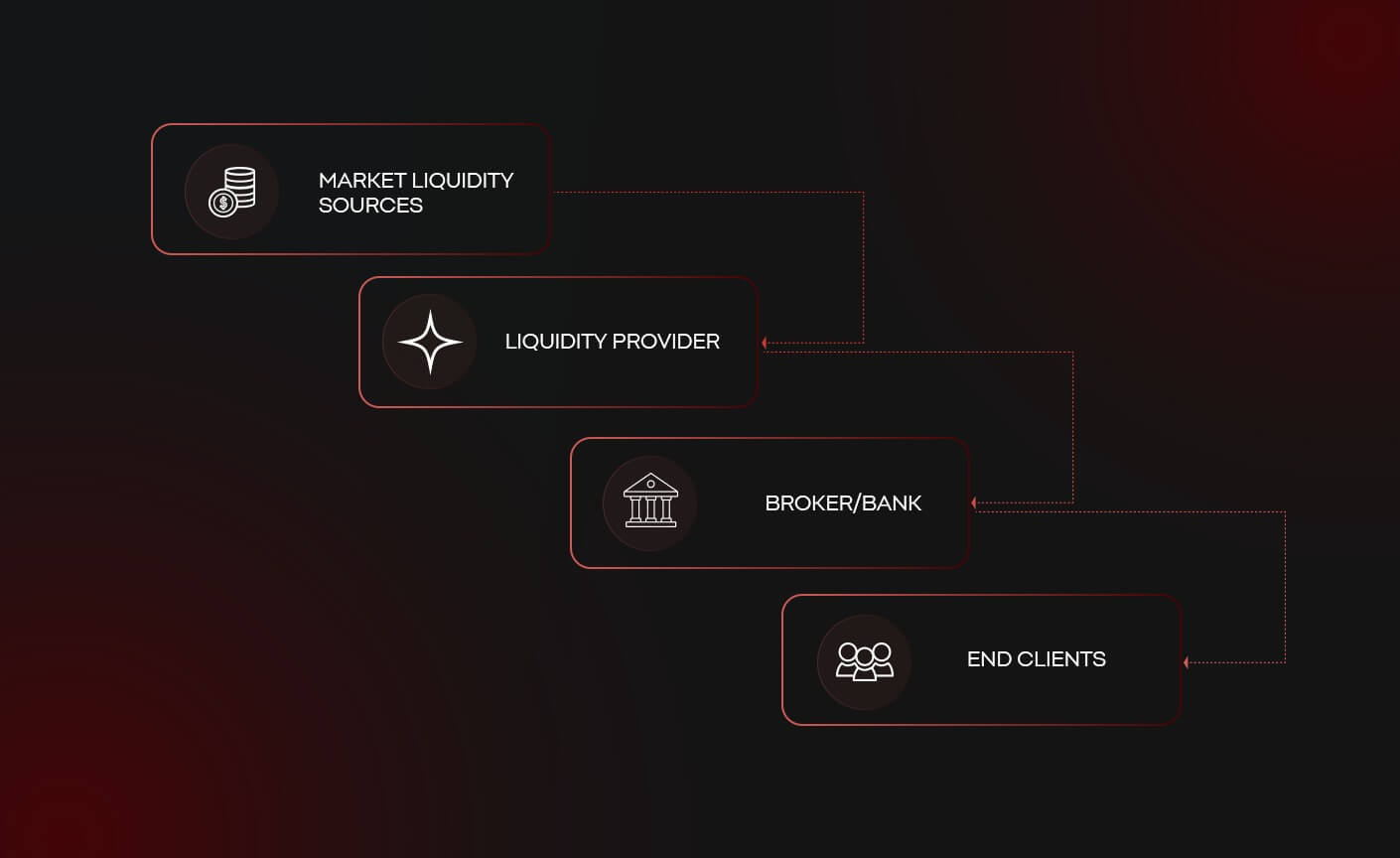
Robust liquidity architecture underpins a broker’s trading infrastructure. Deep market access can support more consistent execution, reduce order rejections and help brokers manage trading activity across diverse market conditions. Some of the key benefits of reliable liquidity are:
LPs provide access to stable liquidity channels, which can support more consistent trade execution. This may help reduce negative slippage and execution latency during periods of increased market volatility, supporting stronger long-term client trust.
Deep market access can help reduce avoidable order rejections and support more stable trading conditions across different market environments. Access to multiple price tiers can also make it easier to handle larger institutional and retail orders without placing excessive pressure on available liquidity.
Partnering with liquidity providers allows brokers to route trades externally after reaching internal risk thresholds. This can help them continue servicing client activity beyond their internal risk limits while reducing exposure to excess trading volume.
Reliable liquidity provider relationships can support flexible risk management. Brokers may use different execution models, including A-Book routing, B-Book internalisation or hybrid risk-offsetting strategies. This flexibility allows them to adapt their risk approach to changing market conditions, client flow and asset-class characteristics.
LPs can support operational scalability by helping brokers manage higher trading volumes through a single liquidity relationship. A multi-asset setup may also reduce the complexity of maintaining separate integrations, contracts and reporting processes across multiple providers.
A trusted liquidity provider can give brokers the technical resilience and operational flexibility needed to support growing trading volumes while reducing the risk of downtime and operational disruption.
As client expectations evolve, many brokers are expanding beyond a single asset class to offer broader market access. A multi-asset setup can help them respond to changing demand and provide access to forex, indices, commodities, cryptocurrencies and individual stock CFDs within one offering.
Managing multiple asset classes under a unified liquidity framework simplifies daily administrative tasks and collateral management. It also maximises existing technical architecture, eliminating the need to and cost of integrating separate platforms for different asset types. In addition, a streamlined setup reduces the operational burden of managing multiple provider relationships, separate contracts and fragmented reporting channels.
Managing multiple instruments within one framework can support more efficient capital and margin management. It may also reduce the need to allocate funds separately across different platforms and provider relationships.
By partnering with XTB Institutional, brokers and banks can access more than 5,000 instruments, sourced from its parent company, WSE-listed XTB S.A. This can reduce the need to maintain multiple provider relationships.
Liquidity requirements vary depending on the counterparty’s operational model, client base and growth strategy. XTB Institutional provides liquidity access tailored to the needs of brokers, banks and other financial institutions.
Multi-Asset Liquidity Streams: Access live pricing across thousands of CFD instruments, including forex, stocks, indices, commodities and cryptocurrencies. This allows brokers to broaden their product offering through a single liquidity relationship.
Deep Order Book Access: Access to deep market volume across multiple price tiers can support the execution of different order sizes. It may also help reduce market impact when clients place larger trades.
Transparent Pricing Models: Transparent pricing models help brokers understand the full cost structure, including spreads, commissions, markups and overnight swaps. Clear commercial terms can support more effective cost management and strengthen trust among clients.
Reliable Execution Performance: Reliable liquidity can support smooth trade execution during both routine market sessions and periods of increased volatility. Stable fill rates and low-latency routing may also help reduce unnecessary order rejections and limit the impact of changing market conditions on the client experience.
Flexible Risk-Management Support: Support flexible risk-management workflows, including A-Book routing, B-Book internalisation and hybrid risk-offsetting strategies. This flexibility can help brokers adapt their execution approach to changing market conditions, client flow and internal risk policies.
Institutional Market Access: Access to wholesale liquidity pools can support the execution of larger transaction volumes for regulated institutional counterparties, while meeting established operational and corporate requirements.
Multi-Asset Liquidity Integration: Reliable liquidity providers can stream live multi-asset pricing into existing institutional systems and enterprise platforms. This can support more efficient handling of institutional flows while limiting disruption to established infrastructure.
Seamless Platform Connectivity: Banks can connect established technology stacks using standardised protocols such as FIX API and other compatible integration solutions. This can support stable and secure connectivity with existing institutional systems.
Experienced Operational Support: Specialised technical account managers can provide support tailored to the operational requirements of banks and financial institutions. XTB Institutional offers dedicated assistance with onboarding, troubleshooting and ongoing operational processes.
Specialised technical account managers can provide support tailored to the operational requirements of banks and financial institutions. XTB Institutional offers dedicated assistance with onboarding, troubleshooting and ongoing operational processes.
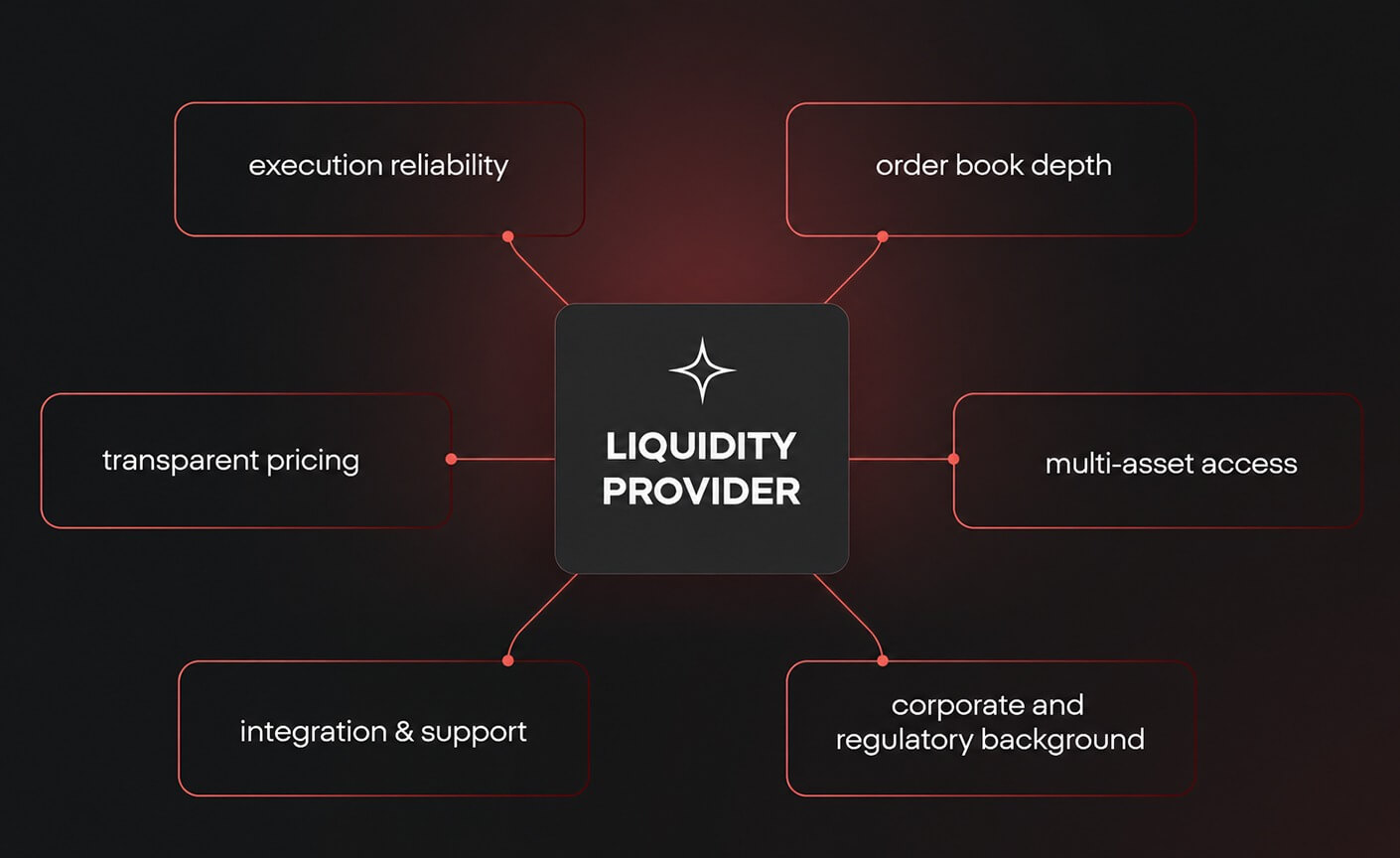
Assess whether the LP provides low-latency routing, consistent fill rates and transparent information on order rejections. Reviewing execution performance during major market events can also show how the provider responds to sudden increases in volatility.
Check the liquidity provider’s market depth across multiple price tiers. This ensures that larger orders can execute without disproportionate slippage. Visibility beyond top-of-book pricing allows you to confidently onboard institutional clients and high-volume traders.
Consider how the LP handles slippage. Slippage should be fair and go both ways. When the market moves in your client’s favour, your liquidity provider should pass those positive price improvements on to them.
Evaluate pricing transparency by reviewing total costs, including spreads, clearing fees, commissions, markups and swap charges. A fully unbundled cost breakdown prevents hidden fees from quietly eroding your operating margins over time.
Choose a B2B institutional LP whose asset coverage aligns with your firm’s immediate expansion plans and client demand. Broad multi-asset access lets you capture shifting market trends across markets without needing new vendor contracts.
Brokers can launch products and services faster by partnering with LPs that provide clear technical documentation, integration support and streamlined onboarding processes.
Streamlined technical integrations reduce deployment costs meaningfully and minimise reliance on third-party engineering resources.
Clearly discuss your expectations, for example, do you need 24/7 or 24/5 technical account assistance? Direct access to dedicated technical specialists helps resolve critical routing issues before they affect end-client experiences.
Clean post-trade reporting is just as important as fast execution. A good partner will give you detailed transaction logs and compliant trade reports.
Also, technical glitches can happen to anyone. That’s why reliable LPs maintain redundant backup servers and disaster recovery plans to keep their trading systems online even if an outage occurs.
XTB Institutional uses distributed data centres to support system resilience and service availability.
Reviewing the parent group’s corporate hierarchy, financial history, listing status and regulatory licenses can offer important insights. Partnering with an audited, publicly listed group gives your counterparties and auditors higher confidence in your platform’s operational security.
In addition, check the corporate and regulatory background of the provider to gauge support for transparency, governance and long-term credibility. XTB Institutional is backed by XTB Group. Its parent company, XTB S.A., is listed on the Warsaw Stock Exchange and operates through entities supervised across multiple jurisdictions.
Your chosen LP’s commercial model, fee structures, growth roadmap and partnership flexibility must align with your brokerage’s long-term operational scale and expansion strategy. Establishing a flexible, long-term commercial structure can keep your liquidity relationship profitable as your trading volumes grow.
Choosing a liquidity provider should not be based on headline spreads alone. Brokers must thoroughly assess execution quality, market depth, transparent commercial conditions, multi-asset access, integration support and the provider’s overall corporate background. A holistic evaluation ensures a secure operational environment, capable of scaling with market demand. XTB Institutional provides multi-asset institutional liquidity for brokers and banks, backed by the experience and corporate framework of XTB Group. Speak to our experts to learn more about XTB Institutional’s multi-asset liquidity and execution capabilities.
What does a liquidity provider do for a broker?
A liquidity provider supplies continuous price quotes and trade execution capabilities. This enables brokers to quickly fill client trade requests, maintain competitive bid-ask spreads and manage internal trading risk.
What types of liquidity providers are there?
The main types include Tier 1 providers (major banks), Prime-of-Primes (PoPs), active non-bank market makers and B2B institutional liquidity providers.
Why is market depth important?
Market depth measures the volume of buy and sell orders at any given time, at various price levels beyond top-of-book. Sufficient depth reduces slippage, especially when brokers execute larger orders or during periods of high volatility.
What does a multi-asset liquidity provider offer?
A multi-asset LP provides trade execution and pricing streams across multiple asset classes, such as forex, indices, spot commodities, individual stock CFDs, cryptocurrencies and ETFs.
How does a broker connect to a liquidity provider?
Brokers typically connect to liquidity providers through standardised protocols such as FIX API or other compatible integration solutions. The available connection method depends on the provider’s infrastructure and the broker’s technical requirements.
What should a broker consider when choosing a liquidity provider?
Some of the key considerations include execution speed, order fill rates, depth of order books, transparency in pricing, asset selection, quality of technical support and the LP’s legal and regulatory status.
What is more important than the headline spread when choosing a liquidity provider?
Headline spreads should be considered alongside execution quality, available market depth, fill rates, slippage, order rejection conditions and the provider’s overall pricing structure. A narrow quoted spread does not necessarily translate into lower execution costs if orders experience frequent rejections or significant slippage.
Why does the corporate and regulatory background of a provider matter?
Finance is a strictly regulated industry. An LP’s corporate and regulatory standing defines its legal compliance, financial stability and operational governance. Working with an established partner backed by a strong corporate and regulatory framework can help reduce counterparty risk and support long-term operational resilience.